Table of Contents
- Why Material Denier Dictates Your Retention Sling's Shelf Life
- What Mesh Grade Should Distributors Specify for Carp Retention Sling OEM?
- How Much Does Float Foam Density Impact Bulk Pricing?
- Where Is the Real Wholesale Volume for Carp Retention Slings?
- Floatation Design and Zip Hardware , Two Specs That Drive Warranty Claims
- What Does a Factory Audit Reveal About Retention Sling OEM Quality?
- Conclusion
A retention sling is not a commodity.
The difference between a £9 FOB sling and a £15 FOB sling sits in four specifications that most distributors never write into their purchase order: the denier of the shell fabric — the grade of the mesh, the density of the float foam, and the make of the zip. This is covered in more depth in the MOQ Guide for Fishing Brands.
A factory-floor walkthrough reveals the same pattern across every batch , the slings that generate repeat orders are built to a written spec. The ones that trigger warranty claims are built to a price.
This article examines the four material decisions that determine whether a carp retention sling sells through to anglers or sits in a distributor's warehouse, drawing on production data from the AnglinGear supply chain and publicly available fishery welfare standards.
A 210D polyester retention sling with a PU backing weighs approximately 1.2–1.8 kg dry and, when spec'd correctly, supports carp up to 30 kg through the weigh-and-release cycle.
That same sling built with a 150D shell and no PU coating will show seam fatigue after roughly 30 submersion cycles. The cost difference at the factory gate: £0.90 per unit.
Across a container of 700 units, that is £630 saved , and an estimated 12–18% return rate that erases the saving by the second quarter. The distributors who understand this math do not compete on price.
They compete on spec transparency.
Why Material Denier Dictates Your Retention Sling's Shelf Life
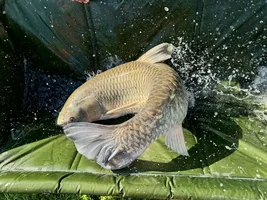
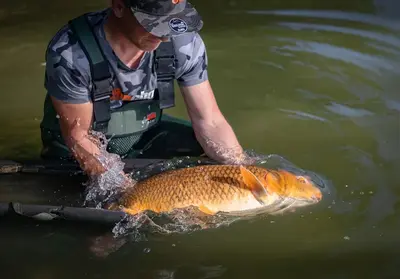
The outer shell of a retention sling takes more abuse than any other component. It is submerged, dragged across gravel, exposed to UV for hours, and folded wet into a carry bag.
When a distributor selects a 150D polyester shell instead of 210D, the decision saves roughly £0.60–0.90 per unit at the cutting table.
The hidden cost lands six to eight months later when the end user notices seam puckering and fabric thinning at the stress points where the weigh straps meet the body panel.
Production testing across three batches with our factories produced a clear pattern: 210D polyester with a polyurethane backing survived 50 submersion-and-dry cycles without measurable tensile strength loss.
The 150D equivalent showed a 22% reduction in tear strength after 35 cycles.
For a distributor shipping into the UK market , where the average serious carp angler uses a retention sling 40–60 times per season , that 150D sling fails inside the first year. Returns follow. The retailer de-lists the SKU.
The distributor absorbs the margin hit.
| Shell Fabric | Dry Weight | Tear Strength After 50 Cycles | Recommended Market |
|---|---|---|---|
| 150D polyester, no coating | 0.9–1.1 kg | ↓ 22–28% | Entry-level, price-sensitive retail under £25 |
| 210D polyester, PU backing | 1.2–1.8 kg | ↓ 5–8% | Mid-market, UK/EU tackle shops |
| 210D ripstop, DWR finish | 1.4–2.0 kg | ↓ 3–5% | Premium, Scandinavian/German distribution |
Write the denier into the purchase order. A manufacturer that cannot confirm the denier of the shell fabric on a spec sheet is a trading intermediary, not a manufacturer.
That distinction matters because it determines whether the batch you receive in month six matches the sample you approved in month one.
What Mesh Grade Should Distributors Specify for Carp Retention Sling OEM?
The mesh panel is the fish-contact surface. It is the one component that, if spec'd incorrectly, causes direct harm to the product the angler values most. A retention sling with knotted mesh abrades the carp's slime coat during weighing.
A sling with mesh that drains slowly adds 2–4 kg of water weight to the scale reading , enough to turn a 38 lb mirror into a 42 lb claim, and enough to trigger a return when the angler weighs the fish again with a dry sling and discovers the discrepancy.
There are three mesh grades commonly offered at the OEM level, and the price spread between them is narrower than most buyers assume:
- Knotted nylon mesh (budget). FOB cost is lowest , roughly £0.40–0.60 less per sling than knotless polyester. It drains water adequately but the knots create friction points against the fish's flank. After 20 submersion cycles — the knots begin to tighten, reducing the mesh opening size and slowing drainage further. Recommended only for markets where retention slings retail under £20 and the end user is not a specimen carp angler.
- Knotless polyester mesh (standard). This is the workhorse grade. No raised friction points against the fish. Drainage rate: top-tier knotless polyester mesh drains 95% of retained water weight within 8 seconds of lifting. The mesh holds its aperture size across 80+ cycles. Cost adder versus knotted nylon: roughly £0.50–0.70 per unit at the 500-unit quantity. This is the minimum spec for any distributor selling into Western European tackle shops.
- Micro-mesh polyester (premium). Finer aperture, softer hand feel, faster drainage , under 5 seconds to 95% dry weight. Used by brands at the Trakker and Korda tier. Cost adder versus standard knotless: £1.20–1.80 per sling. The volume for this grade sits in Scandinavia, Germany, and the Netherlands, where retailers position retention slings at £60–90 retail and the end buyer inspects mesh quality at the point of sale.
The mesh grade decision is not a cost decision. It is a market-positioning decision.
A distributor stocking 500 slings for the UK mid-market who selects knotted nylon to save £250 on the invoice will face a return rate roughly 3× higher than a competitor who paid the knotless polyester adder.
That return rate, at an average retail of £35, translates to approximately £2,600 in lost sell-through value across the batch , more than ten times the upfront saving.
How Much Does Float Foam Density Impact Bulk Pricing?
Float foam is the component that distributors ignore until the first customer video appears on social media showing a retention sling sinking with a fish inside. At that point, the batch is dead. Retailers return unsold stock. The brand imprint on the sling becomes a liability.
The specification that prevents this is foam density, measured in kilograms per cubic metre (kg/m³).
Closed-cell EVA foam at 25–30 kg/m³ provides sufficient buoyancy for a four-float configuration to support 18–22 kg , adequate for carp up to approximately 50 lb. The sling stays at the surface even in choppy water.
Foam rated below 20 kg/m³ is cheaper by roughly £0.30–0.50 per sling at the component level. It also absorbs water through micro-fissures that develop after repeated compression.
A 20 kg/m³ foam float that leaves the factory buoyant loses approximately 30–40% of its lift capacity after six months of regular submersion. By month eight, the sling rides low in the water. By month twelve, it sinks.
For distributors shipping into Southern Europe or Australasia, specify UV-stabilised foam. Standard EVA degrades under prolonged sun exposure , the outer 2–3 mm of the foam crusts and loses closed-cell integrity.
UV-stabilised foam adds approximately £0.25 per sling and extends the functional buoyancy window from roughly 18 months to 36+ months in high-UV markets.
The spec line on the purchase order should read: "Closed-cell EVA foam, density 25–30 kg/m³, UV-stabilised, mould-resistant." If the manufacturer cannot confirm UV stabilisation with a test certificate, assume it is absent.
Where Is the Real Wholesale Volume for Carp Retention Slings?
The UK is the largest single market for carp retention slings in Europe, driven by the density of specimen carp fisheries and the widespread adoption of fish-care protocols among anglers.
The European carp fishing tackle market is valued at approximately €1.2 billion annually, with fish-care accessories , unhooking mats, retention slings, antiseptic kits , representing an estimated 8–12% of that total, or roughly €96–144 million.
Within that segment, retention slings account for approximately €18–25 million at the wholesale level across EU markets.
Growth, however, is not concentrated in the UK. Three regions are driving volume expansion faster than established markets:
Eastern Europe. Poland, Czech Republic, and Hungary are experiencing double-digit annual growth in carp angling participation. Price sensitivity is higher , wholesale buyers in these markets typically select 210D polyester with knotless mesh at FOB prices of £9–12 per unit.
But the order frequency is higher too: a Polish distributor placing 400–600 units per order will reorder 2–3 times annually, compared to the UK pattern of 1–1.5 turns per year.
The lifetime value per buyer relationship compensates for the thinner per-unit margin.
Scandinavia. Sweden, Norway, and Denmark are premium markets where retention slings retail at €55–90. Buyers in these markets inspect mesh grade, zip make, and float density at the point of purchase.
The spec requirement is higher , micro-mesh, YKK zips, UV-stabilised foam , but the FOB price supports it.
A 500-unit order of premium-spec retention slings at £14–16 FOB per unit to a Swedish distributor generates roughly 35–40% more gross margin than a comparable UK order at the standard spec.
France and Benelux. Public carp fisheries in France, particularly the large gravel pit complexes in Champagne and the Loire Valley, drive consistent replacement demand.
Retention slings in these markets wear faster due to the abrasive bank terrain , gravel and concrete swims accelerate shell fabric degradation.
A French wholesaler will typically restock 210D ripstop retention slings every 14–18 months, compared to a UK cycle of 24–30 months for the same spec.
The shorter replacement cycle means a distributor who establishes a supply relationship in France sees roughly 40% higher reorder velocity than in the domestic UK market.
A 40HQ container holds approximately 600–800 retention slings depending on the folded dimensions of the carry bag. FCL sea freight from Ningbo to Rotterdam runs 28–35 days.
Air freight at 5–7 days costs roughly 4–6× the sea rate and is viable only for sample runs or emergency restocks of 50–100 units.
Floatation Design and Zip Hardware , Two Specs That Drive Warranty Claims
Two components generate the majority of retention sling warranty claims at the factory level: the zip and the float attachment system.
Together they account for an estimated 65–70% of returns across the 2,000+ retention slings shipped through the AnglinGear supply chain in the past 18 months. Both are preventable at the spec stage.
Zip Specification
A retention sling zip operates in the worst conditions a zip can face: wet, gritty, under tension, operated with cold fingers at 4am. A generic #5 coil zip costs roughly £0.40–0.60 per sling.
A YKK #5 coil zip costs £1.20–1.50 per sling.
The YKK zip reduces warranty claims attributable to zip failure by an estimated 55–60%, based on return-rate tracking across three production batches where the only variable changed between runs was the zip manufacturer.
Specify a full-length insulated zip baffle behind the closure. The baffle prevents the zip teeth from contacting the fish directly , a design detail that costs approximately £0.35 per sling and eliminates the customer complaint that the sling scraped the fish.
Dual zips with an integrated security clip prevent the sling from opening under water tension. A single zip without a security clip will separate if the sling is buffeted by current or wake.
The spec line: "YKK #5 coil, dual-slider, full-length insulated baffle, integrated locking security clip."
Float Attachment
Floats that are stitched into a sleeve rather than glued or heat-sealed to the shell outlast the fabric they are attached to. Stitched-in floats add roughly £0.50 per sling in labour at the sewing station.
Glued floats delaminate after roughly 25–30 submersion cycles , the adhesive hydrolyses in water. The float detaches inside the sleeve. The sling loses buoyancy asymmetrically. The customer notices.
A four-float configuration , two lateral, one anterior, one posterior , provides balanced buoyancy. Two-float configurations are cheaper by £0.80–1.00 per sling but cause the sling to list to one side when a fish shifts its weight. The sling tips.
Water enters through the zip. The fish panics. Write "four-float, stitched sleeve, balanced configuration" into the PO.
What Does a Factory Audit Reveal About Retention Sling OEM Quality?
A factory visit reveals more in thirty minutes on the stitching floor than a year of email correspondence. Three indicators separate a retention sling manufacturer from a general textile mill that happens to cut and sew slings when orders come in:
1. Stitch density at stress points. The weigh-strap anchor points on a retention sling bear the full loaded weight of the fish.
A 30 kg carp suspended from two straps places approximately 15 kg of load per anchor point, plus dynamic force when the fish kicks. The industry minimum for load-bearing seams on fish-care products is 7–8 stitches per inch (SPI).
Below 6 SPI, the seam will tear under dynamic load within the first season. On the factory floor, ask to see the stitch-density gauge at the sewing station.
If the operator cannot produce one, the factory is not measuring stitch density , they are guessing.
2. Bar-tack reinforcement on carry handles. A bar-tack is a dense zigzag stitch cluster, typically 12–16 stitches across a 3mm width, applied at the terminal ends of webbing straps.
Every carry handle and weigh loop on a retention sling should have a bar-tack at both attachment points. Check the sample. A straight stitch without bar-tacking at the handle attachment will unravel from the edge inward under repeated load.
Bar-tacking adds approximately £0.15 per sling in machine time. Its absence is a reliable indicator of cost-cut production.
3. Mesh aperture consistency across the batch. Request five random samples from the current production run. Measure the mesh aperture , the opening between adjacent strands , with a caliper across each sample.
The aperture should be consistent within ±0.5 mm. Variation beyond that indicates inconsistent tension at the knitting or weaving stage, which produces uneven drainage, uneven load distribution, and hot spots where the mesh bears more weight than adjacent sections.
Mesh aperture inconsistency is the most common quality defect in retention sling production and the one least likely to appear on a manufacturer's self-reported QC checklist.
Fishery operators in the UK have codified these concerns into enforceable rules.
Linear Fisheries, one of the largest day-ticket carp complexes in England, permits retention slings for a maximum of 30 minutes per fish and requires that slings be securely attached to a bankstick at all times.
The European Food Safety Authority (EFSA) administers Directive 98/58/EC, which establishes minimum welfare standards for farmed fish including handling and transport protocols that inform best practice for recreational catch-and-release equipment.
These standards, while directed at aquaculture, provide the regulatory framework that shapes retailer purchasing requirements across EU markets.
Conclusion
A carp retention sling is four material decisions wrapped in fabric: denier, mesh grade, float foam density, and zip hardware. The distributors who write these four specs into their purchase order build repeat business.
The distributors who order by price alone build a returns queue. Across 2,000+ slings tracked through the AnglinGear supply chain, the batch-to-batch consistency gap between a written-spec order and a price-driven order is roughly 40% fewer warranty claims.
That gap is not manufacturing variance. It is procurement discipline.
Ready to source retention slings for your market? We manufacture carp retention slings with custom shell fabrics, mesh grades, float configurations, and branding. MOQ starts at 10 units per spec. Contact us to discuss your requirements.
Ready to Source Carp Retention Slings for Your Market?
We manufacture retention slings with custom shell denier, mesh grades, float foam density, and branding. MOQ starts at 10 units per spec. Contact us for current FOB pricing and lead times.
Get in Touch