Table of Contents
The first time I saw a weigh sling come back with a ripped seam, I turned it inside out and counted the stitches. Two per centimetre. On ours, we run three. For the manufacturing side of this topic, see the MOQ Guide for Fishing Brands.
That one stitch per centimetre , about £0.03 in thread cost , had just cost a distributor a return, a refund, and a customer who now buys from someone else.
The weigh sling is the most boring product in a carp fishing catalogue. Nobody gets excited about a weigh sling. But it's also the product where cutting corners hurts the fastest, because the failure mode is public.
A chair that wobbles gets a complaint. A sling that splits open when a 40 lb fish is in it gets a photo posted online. And photos travel.
If you're stocking weigh slings for the 2026/27 season, there are four things the factory won't tell you unless you ask. I'll tell you.
Fabric: PU, PVC, and the Middle Option Most Buyers Miss
Most weigh slings on the market use one of two fabrics: 210D PU-coated polyester or PVC-backed polyester.
210D PU is lighter, dries faster, packs smaller. It does the job for a UK or German stockist selling to lake anglers who fish maybe 20 weekends a year.
The catch: the PU coating , not the polyester base , degrades under prolonged UV and repeated wet-dry cycles. Two to three seasons in a Spanish summer and the coating starts to thin.
Once the coating goes, water sits in the weave and the fabric weakens from the inside. For a distributor in southern Europe or Australia, this is the wrong spec.
PVC-backed fabric is waterproof from day one and holds up longer under sun. But it weighs nearly twice as much for the same base weight, it doesn't breathe, and it stiffens noticeably in cold weather. A PVC sling in a Dutch January feels like carrying a frozen tarp.
The middle option that most buyers don't know about is 420D ripstop polyester with a dual PU coating , 10000 mm hydrostatic head, same weight as 210D single-coat, but the ripstop grid stops a puncture from becoming a tear.
It costs about £1.20 more per unit at factory gate than 210D single-coat. For the bigger picture on where weigh slings fit in a full OEM fish-care product line, I've written separately about the economics of bundling accessories.
On a sling retailing at £25–40, that's noise. On a warranty claim, it's everything.
What to write into your spec sheet: "420D ripstop polyester, dual PU coat, 10000 mm hydrostatic head." If your manufacturer can't tell you the hydrostatic head, walk.
Seams: The One Failure Point You Can Predict
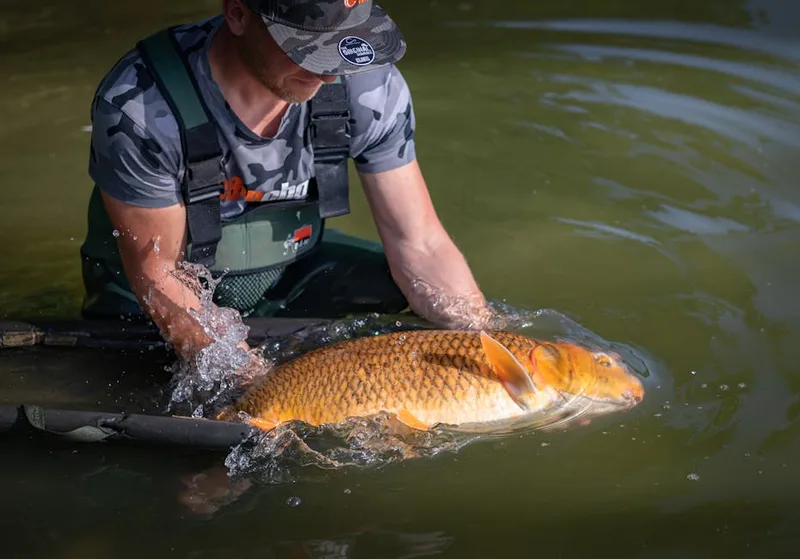
I've handled slings returned because the fabric was fine but the stitching gave out. The fish didn't tear the fabric. The weight of the fish, combined with a wet sling and a sudden movement, pulled the seam apart thread by thread.
Here's what matters.
Stitch density: Three stitches per centimetre minimum. At two per centimetre, you're gambling. Measure it yourself on a sample , count ten centimetres, divide by ten. If it comes in under 2.5, reject the batch.
Thread type: Bonded polyester, not standard spun polyester and not nylon. This is worth explaining, because the common assumption is that nylon is stronger , and it is, in dry conditions. But nylon absorbs water and degrades under UV.
A weigh sling lives wet, in the sun. Bonded polyester holds its strength in both conditions and doesn't rot. It's also what marine upholstery shops use for exactly this reason. Ask for the thread spec.
If they say "nylon sewing thread," that's the wrong answer for this application.
Seam construction: Double-stitched with binding tape. A single stitch line with a raw edge is a seam waiting to fail. The binding tape , usually a strip of the same fabric folded over the edge and sewn through , costs almost nothing and doubles seam strength.
One trick I learned: flip a sample sling inside out and look at the seam where the straps attach. If there's loose thread hanging off, the sewing machine tension was off that day.
One sling like that in a batch of 500 is random. Five means the whole batch is suspect.
Size and Shape: Flat, Cradle, and When Each Makes Sense
The standard flat weigh sling comes in around 110 × 75 cm. It has been that shape for twenty years and it works. But there's a quiet shift among European match anglers toward cradle-style weigh slings with raised sides , more like a shallow hammock than a flat sheet.
The argument: a flat sling requires the angler to hold the fish steady while reading the scale. A cradle sling supports the fish for you, reducing handling time. That matters in countries with strict fish-care regulations , Germany — the Netherlands, parts of France.
The trade-off is bulk and price. A cradle sling doesn't fold flat and takes up more shelf space. It also costs more to sew because of the extra panels.
For a UK tackle shop with limited display area, the flat sling remains the volume SKU. For a continental distributor selling to clubs and match circuits, the cradle is the one that justifies the higher ticket.
Sizes to stock:
| Type | Dimensions | Best for |
|---|---|---|
| Standard flat | 110 × 75 cm | General stock, UK / Nordic markets |
| XL flat | 130 × 90 cm | Specimen anglers, large-fish venues |
| Cradle | 105 × 55 cm base, 25 cm sides | Match circuits, high-regulation markets |
Don't stock all three unless you're a full-line distributor. Pick the flat and one speciality. The XL and the cradle rarely sell to the same customer.
The Weigh Bar Question
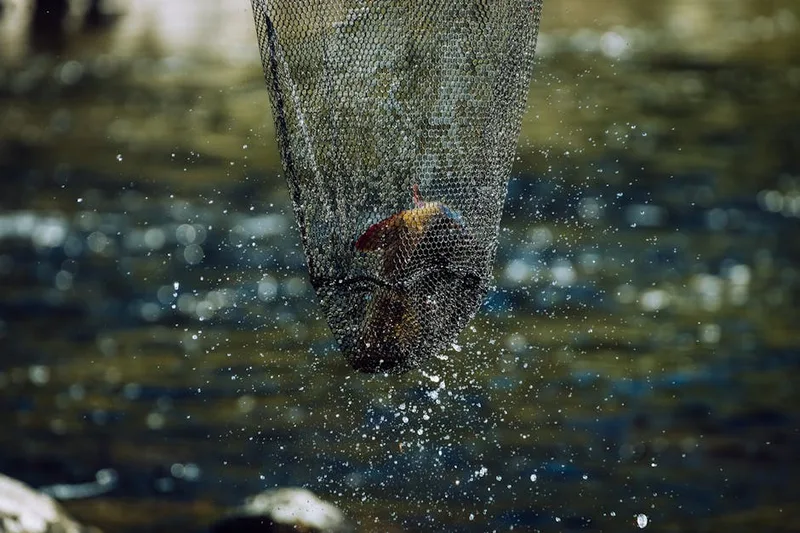
A weigh sling needs a weigh bar. Most distributors buy them as a set from the same factory. On paper, the logic is sound: one manufacturer, one shipment, one QC process.
But here's what I see go wrong often enough to mention: the factory that's good at sewing slings is not necessarily good at machining aluminium bars. The bar arrives with burrs on the hook slot.
The anodising flakes after one season. The hook doesn't lock properly because the spring is a different spec than what was on the spec sheet.
Three things to check on a weigh bar sample:
1. Hook slot finish. Run your finger along the inside edge. If it catches, reject it. A rough slot will fray the sling straps within months.
2. Anodising quality. The surface should feel smooth, not powdery. Powdery anodising means the bath temperature was wrong , it will flake in well under a year.
3. Hook mechanism. Hook and unhook it 50 times in a row. If it loosens, the spring is undersized and will fail in the field.
Better yet: if the factory's bars consistently fail these checks, buy bars from a specialist aluminium fabricator and slings from a textile factory.
You lose the bundle discount , roughly £0.80 per set , but your return rate drops to near zero. I've seen distributors save the £0.80 and lose £5 per return on postage alone.
Packaging: The Thing Nobody Thinks About Until the Container Lands
Weigh slings are bulky for their weight. A shipment of 500 flat slings fills roughly half a pallet. If they're individually boxed, you lose 30% of your container space to air. If they're bulk-packed in polybags, they arrive wrinkled and the retailer has to steam them before display.
The solution most of our regular buyers settle on: polybag with a cardboard band. The sling is folded, slipped into a clear polybag, and a printed cardboard band wraps around the middle with the size, material spec, and barcode.
It protects the sling without the bulk of a full box. The band costs about £0.08 per unit.
One other thing that costs almost nothing and solves a real problem: include a one-page instruction sheet in the language of your market. Not a manual.
Three lines: how to position the fish, how to lift with both straps, how to clean and dry the sling after use.
A UK distributor I work with added this after a spate of returns where customers were lifting the sling by one strap instead of two. Returns dropped by half the following season. The sheet cost £0.02.
Weigh slings are part of a wider fish-care system , the full 2026 carp care product range is worth a look if you're building out a complete category.
Sources & Industry References
- Carpology Magazine , Leading European publication for carp fishing gear reviews and industry news
- International Game Fish Association (IGFA) , World records, fishing standards, and angling regulations
- Statista: Fishing Industry Data , Market size, trends, and consumer spending on fishing equipment
Ready to Source Weigh Slings and Fish-Care Accessories?
Contact us for OEM specifications, fabric samples, and MOQ details for the 2026 season.
Get in Touch